

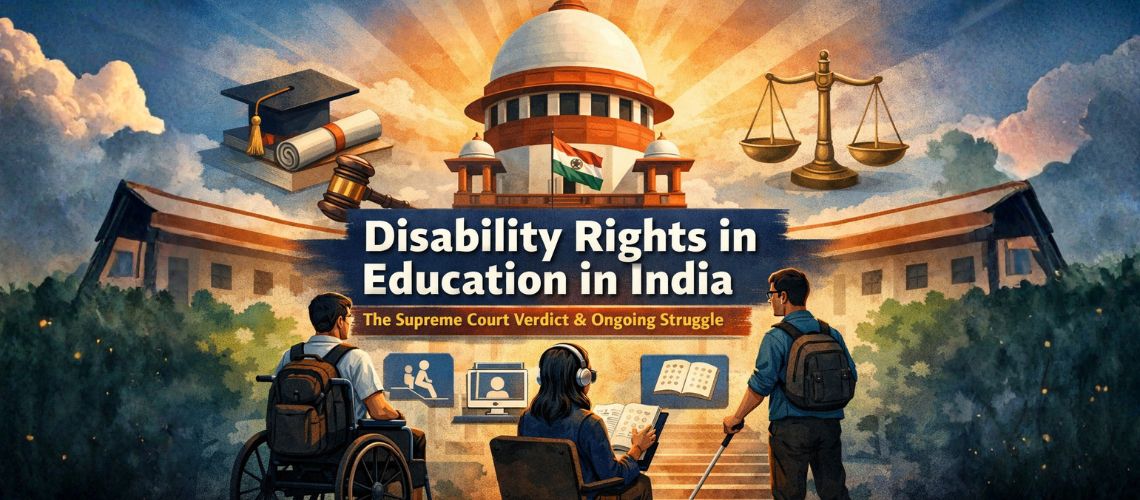
Case Brief: Disabled Rights Group vs Union of India
In Disabled Rights Group & Anr. vs Union of India & Ors. (2017), a disability rights organisation approached the Supreme Court of India after years of systematic exclusion of persons with disabilities from higher and professional education. The petition revealed that universities and regulatory authorities were failing to implement mandatory reservation, age relaxation, and accessibility norms, despite clear statutory obligations. Institutions continued to deny admissions, operate inaccessible campuses, and treat reasonable accommodation as a discretionary favour rather than a legal right.
The case forced the Supreme Court to examine a critical question: Can education be called “equal” if persons with disabilities are admitted but denied access, accommodation, and dignity? This ruling became a defining moment for Disability Rights in Education in India, shifting the focus from token inclusion to real equality.
The Court’s answer was unambiguous.
✅ If you want to understand how multiple landmark rulings have strengthened disability justice over time, explore our detailed guide on Supreme Court Disability Rights Cases That Shaped Indian Law
From Charity to Rights: Redefining Disability in Education
One of the most important contributions of this judgment was its rejection of the outdated charity-based approach to disability. The Court affirmed a rights-based and social model of disability, recognising that disability is not caused merely by impairment, but by social, structural, and institutional barriers.
In simple terms:
- A wheelchair user is disabled not by paralysis, but by stairs without ramps
- A blind student is disabled not by vision loss, but by inaccessible study material
- A deaf student is disabled not by hearing impairment, but by the absence of interpreters
This shift places responsibility squarely on educational institutions and the State, not on the individual.
The Legal Framework: What the Law Actually Guarantees
India’s disability rights framework is neither weak nor unclear. The problem lies in enforcement.
Rights of Persons with Disabilities Act, 2016 (RPwD Act)
The RPwD Act is a rights-based legislation aligned with the UN Convention on the Rights of Persons with Disabilities (UNCRPD), which India ratified in 2007.
Key education-related guarantees include:
- Inclusive education at all levels
- 5% reservation in higher educational institutions for persons with benchmark disabilities
- Age relaxation in admissions
- Reasonable accommodation, including scribes, readers, interpreters, assistive technology
- Barrier-free access to physical infrastructure, transport, and digital platforms
The Supreme Court clarified that these are enforceable rights, not policy preferences.
Reservation in Higher Education: Mandatory, Not Optional
A central issue in the Disabled Rights Group case was the routine non-implementation of reservation for persons with disabilities.
The Court categorically held that:
- Reservation is a statutory obligation
- Institutions cannot plead administrative difficulty or lack of preparedness
- Regulatory bodies like UGC and professional councils are duty-bound to monitor compliance
Despite this clarity, ground reality remains troubling.
The Numbers Tell the Story
- Persons with disabilities constitute approximately 4–5% of India’s population (around 6–7 crore people)
- Yet representation in higher education remains disproportionately low
- Many institutions either leave reserved seats vacant or fail to notify them properly
When reserved seats exist only on paper, exclusion becomes institutionalised.
Accessibility: Admission Without Access Is Discrimination
One of the most powerful observations of the Supreme Court was that admission without accessibility defeats the purpose of education.
Accessibility is not limited to ramps alone. It includes:
- Step-free entry to classrooms, libraries, labs, and hostels
- Functional lifts, accessible toilets, and tactile pathways
- Accessible transport within large campuses
- Digital accessibility of websites, portals, and learning management systems
Yet, even today:
- Many universities remain physically inaccessible
- Disability access audits are either outdated or cosmetic
- Students are admitted but forced to depend on peers for basic movement
The Court recognized this as a violation of equality, dignity, and non-discrimination.
Reasonable Accommodation: A Right, Not a Favour
Another critical contribution of the judgment was its emphasis on reasonable accommodation.
Reasonable accommodation includes:
- Scribes and readers during examinations
- Extra time or modified exam formats
- Accessible study material (Braille, audio, digital formats)
- Sign language interpreters
- Assistive devices and software
The Court made it clear that denying accommodation amounts to indirect discrimination, even if admission has been granted.
Yet, students across India still report:
- Being asked to “manage on their own.”
- Arbitrary rejection of accommodation requests
- Delays that render accommodations meaningless
The Reality on the Ground: Data That Cannot Be Ignored
Despite strong laws and court rulings, outcomes remain deeply unequal.
- Literacy among persons with disabilities is significantly lower than the national average
- Children with intellectual or multiple disabilities have literacy rates as low as 30–40%
- Only a small fraction of disabled students complete secondary or higher education
- Drop-out rates increase sharply after primary school
These figures reflect not inability—but systemic failure.
Why Implementation Continues to Fail
Several structural issues persist:
- Weak monitoring by regulatory bodies
- Lack of penalties for non-compliance
- Inadequate training of teachers and administrators
- Treating disability inclusion as welfare, not rights
- Absence of disabled voices in decision-making
Without accountability, even the strongest judgments lose impact.
This is where disability rights platforms and activists play a critical role.
Disability activism:
- Translates legal rights into public understanding
- Challenges institutional denial and tokenism
- Uses litigation, RTIs, and public pressure to enforce compliance
- Amplifies lived experiences of disabled students
- Ensures that disability is seen as a justice issue—not a sympathy issue
The Disabled Rights Group case itself is proof that rights advance only when challenged.
What Must Change Now
To move from paper rights to real inclusion:
- Accessibility compliance must be tied to funding and accreditation
- Reservation data must be publicly disclosed annually
- Every institution must have a functional disability support cell
- Inclusive pedagogy must be part of teacher training
- Disabled persons must be included in policy design and monitoring
Conclusion: Education as a Measure of Equality
The Supreme Court has made one thing clear:
Education without accessibility, accommodation, and dignity is not equality—it is exclusion by another name.
India does not suffer from a lack of laws.
It suffers from a lack of enforcement.
The truth is clear—Disability Rights in Education in India will remain incomplete unless institutions are held accountable, and access becomes a guaranteed reality rather than a written promise.
Until every disabled student can enter a campus, attend a class, write an exam, and graduate with dignity, the promise of equality remains unfulfilled. And until then, disability rights activism is not optional—it is essential.