
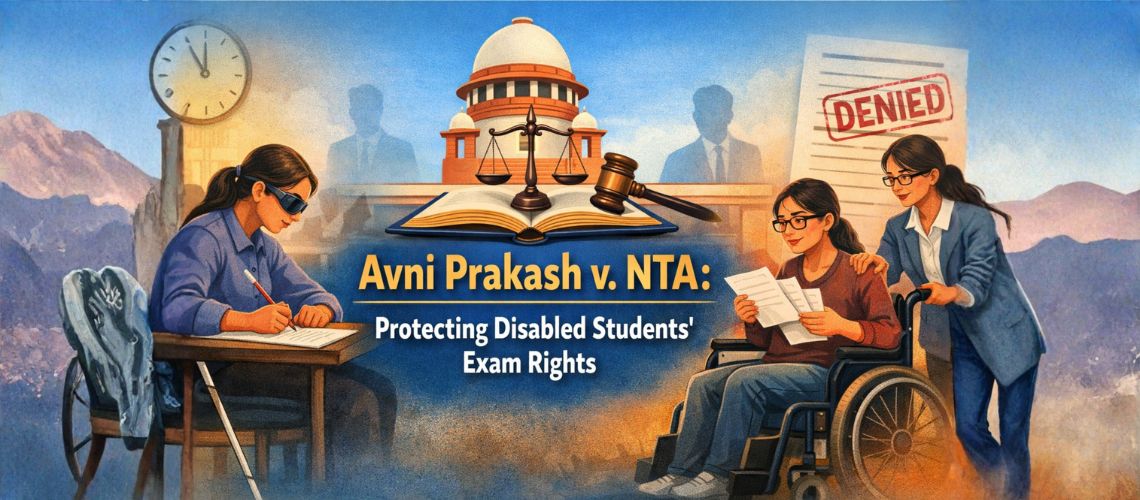
Judgment Explained for Disabled Persons: Avni Prakash v. National Testing Agency
Inclusive Education and Compensatory Time Are Legal Rights, Not Discretion
Judgment Explained for Disabled Persons: Avni Prakash v. National Testing Agency
Introduction: Why This Judgment Matters to Disabled Students
At Disability Activists, the effort has always been to help disabled persons understand one simple truth:
Your rights do not depend on sympathy, goodwill, or the convenience of authorities.
The Supreme Court judgment in Avni Prakash v. National Testing Agency (NTA) is crucial because it exposes how confusion, ignorance, and rigid procedures can permanently damage the future of a disabled student—even when the law is clearly on their side.
This article provides the Avni Prakash v. NTA judgment explained in clear and simple language to help disabled students, parents, and educators understand how inclusive education and reasonable accommodation are enforceable legal rights, not optional facilities. These rights flow directly from the Rights of Persons with Disabilities Act, 2016, which guarantees equality and non-discrimination.
This judgment reaffirms that inclusive education and reasonable accommodation are enforceable legal rights, not optional facilities that authorities may grant or deny at will.
Background of the Case: What Happened to Avni Prakash
Avni Prakash is a student with dysgraphia, a recognised specified disability under the Rights of Persons with Disabilities Act, 2016.
She appeared for the NEET (UG) examination and was legally entitled to one hour of compensatory time, as clearly provided under disability guidelines and the NEET Bulletin.
Despite submitting a valid PwD certificate, the examination centre:
- failed to grant her compensatory time
- forcibly collected her answer sheet after the standard duration
- claimed ignorance of applicable rules
As a result, Avni Prakash was denied a fair opportunity—not due to lack of merit, but due to administrative failure.
Why Disabled Persons Must Know This Judgment
Many disabled students are made to believe:
- “If centre staff don’t know the rules, nothing can be done.”
- “If procedures are confusing, we must adjust.”
- “Complaining may affect our future.”
The Supreme Court firmly rejected this mindset.
Understanding the Avni Prakash v. NTA judgment explained empowers disabled students to assert their rights confidently and ensures that ignorance or confusion of authorities does not destroy academic futures.
Spreading this awareness is a key mission of Panacea Disability Rights Activists, led by Dr. Arvinder Singh, a nationally recognised disability rights educator and activist.
What the Supreme Court Clearly Said
The Supreme Court categorically held that:
- The right to inclusive education is guaranteed under the RPwD Act, 2016
- Inclusive education is achieved through reasonable accommodation, including compensatory time
- Denial of accommodation amounts to discrimination
- Authorities have a positive obligation to ensure equal participation
The Court also clarified that disabled students cannot be punished for:
- ignorance of examination staff
- ambiguous or poorly drafted bulletins
- administrative miscommunication
What “Compensatory Time” Means in Simple Terms
Compensatory time exists to level the playing field, not to give any unfair advantage.
It means:
- additional time to offset disability-related barriers
- a legally recognised form of reasonable accommodation
For NEET and similar examinations:
- compensatory time is available even when no scribe is used
- entitlement flows from PwD status, not reservation category
This entitlement is also supported by the Harmonised Guidelines, which lay down uniform standards for examination accommodations across India.
The Supreme Court clarified that this right applies at the examination stage itself, not merely at admission.
PwD vs PwBD: A Crucial Clarification
A major issue addressed in this case was the misuse of benchmark disability (PwBD) rules.
The Supreme Court clarified that:
- PwD rights under Chapter III of the RPwD Act apply at the examination stage
- PwBD provisions under Chapter VI primarily relate to reservation at admission
- Facilities like compensatory time cannot be restricted only to PwBD candidates
This clarification protects disabled students who are wrongly told they are “not eligible enough.”
How This Judgment Protects Disabled Students in Real Life
This ruling applies to:
- NEET and other entrance examinations
- school and college exams
- competitive and professional tests
- adult and continuing education
The Avni Prakash judgment now stands alongside other Supreme Court disability rights cases that have strengthened constitutional protection for disabled persons.
Any authority that:
- denies compensatory time
- ignores valid disability certificates
- hides behind scale, confusion, or logistics
is acting contrary to constitutional equality.
Why Denial Still Happens
Despite clear law, denial continues because:
- Examination staff lack training
- bulletins are poorly communicated
- disabled students hesitate to assert rights
- authorities prioritise “process” over people
The Supreme Court strongly criticised this mindset, reminding authorities that behind every examination number is a human life and future.
The Mission Behind Disability Rights Awareness
Panacea Disability Rights Activists work on a simple belief:
A right that is not known cannot be exercised.
Under the leadership of Dr. Arvinder Singh—a famous disabled personality of India and a popular disabled entrepreneur & activist—the mission focuses on:
- explaining judgments in simple language
- educating disabled students and parents
- challenging unlawful examination practices
- ensuring legal rights reach the ground level
What You Should Do If You Face a Similar Denial
If you are denied compensatory time or accommodation:
- record the incident immediately
- ask for written reasons
- cite Avni Prakash v. NTA and Vikash Kumar v. UPSC
- approach disability rights organisations
- remember: silence only strengthens unlawful systems
Conclusion: Your Future Cannot Be Sacrificed to Administrative Failure
The Avni Prakash v. NTA judgment sends a clear message:
Disabled students cannot suffer because authorities are unaware, untrained, or confused.
Inclusive education is not a slogan.
It is a constitutional promise.
Equality does not begin when systems become efficient.
It begins when disabled persons know—and claim—their rights.