Despite growing awareness about disability rights in India, many persons with disabilities still face abuse, humiliation, neglect, and exploitation in everyday life. These incidents can occur at home, in workplaces, hospitals, public places, or institutions.
To address these serious issues, the Government of India enacted the Rights of Persons with Disabilities Act, 2016 (RPwD Act) — a landmark law that protects the dignity, safety, and equality of persons with disabilities.
One of the most important provisions of this law is Section 92 of RPwD Act 2016, which specifically deals with punishment for crimes and atrocities committed against persons with disabilities.
This section makes certain acts criminal offenses and provides strict penalties, including imprisonment and fines for those who harm or exploit persons with disabilities.
In this article, we explain Section 92 of the RPwD Act, the offenses covered under it, the punishment prescribed by law, and why awareness of this provision is crucial for protecting disability rights in India.
What Is Section 92 of RPwD Act 2016?
Section 92 of RPwD Act 2016 provides legal punishment for individuals who commit atrocities or serious offenses against persons with disabilities.
The purpose of this provision is twofold:
- To protect the dignity, safety, and rights of persons with disabilities
- To deter people from committing abuse, neglect, exploitation, or violence
Persons with disabilities often face social stigma, dependency on caregivers, and systemic discrimination, which can make them vulnerable to abuse. Section 92 acts as a strong legal safeguard against such violations.
Punishment Under Section 92
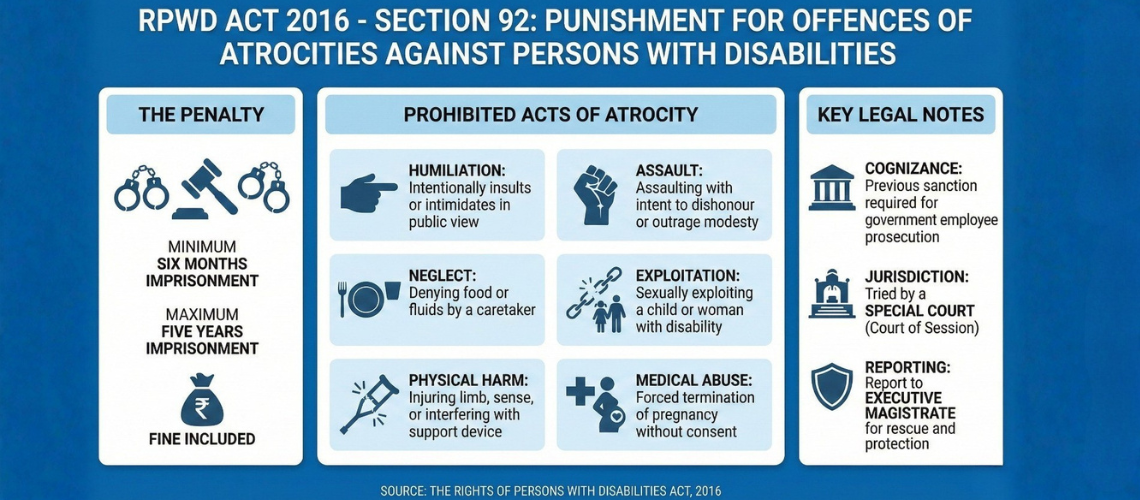
Under Section 92 of the RPwD Act, any person who commits atrocities against a person with disability can face serious criminal punishment.
The law provides:
Minimum punishment
- Imprisonment for 6 months
Maximum punishment
- Imprisonment for up to 5 years
Additional penalty
- Fine may also be imposed
The exact punishment depends on the nature and severity of the offense committed.
This provision sends a clear message that abuse against persons with disabilities is not just unethical — it is a criminal offense.
Offenses Considered Atrocities Under Section 92
Section 92 identifies several acts that are legally classified as atrocities against persons with disabilities.
Below are the major categories of punishable offenses.
1. Public Humiliation or Insult
Any act that intentionally insults, humiliates, or intimidates a person with disability in public is punishable under the law.
Examples include:
- Mocking someone’s disability
- Publicly humiliating a person because of their condition
- Using abusive or degrading language related to disability
Such behavior can cause severe emotional harm and social exclusion, which the law aims to prevent.
2. Physical Assault Intended to Humiliate
If someone physically assaults a person with disability with the intention of humiliating or dishonouring them, it is considered an atrocity.
Examples include:
- Physical attacks
- Harassment meant to degrade dignity
- Intimidation or threats linked to disability
The law treats such actions as serious violations of human dignity and human rights.
3. Neglect by Caretakers
Caretaker neglect is another major offense under Section 92.
If a person responsible for caring for a person with disability intentionally denies basic necessities, it becomes a punishable crime.
Examples include:
- Denying food or drinking water
- Refusing medical treatment
- Withholding essential care or assistance
Since many persons with disabilities depend on caregivers, intentional neglect is treated very seriously under the law.
4. Sexual Exploitation of Women or Children with Disabilities
Women and children with disabilities are often more vulnerable to abuse and exploitation.
Section 92 provides strict punishment for acts such as:
- Sexual harassment
- Sexual exploitation
- Coercion or abuse, taking advantage of disability
These acts are treated as grave crimes under the RPwD Act.
5. Causing Physical Injury or Damaging Assistive Devices
Another offense under Section 92 is causing physical harm to a person with disability or damaging their assistive devices.
Examples include:
- Injuring limbs or causing bodily harm
- Damaging hearing aids, wheelchairs, prosthetics, or other assistive devices
- Interfering with mobility aids
Assistive devices are often essential for independence and mobility. Damaging them directly affects a person’s ability to function and live independently.
6. Forced Medical Procedures Without Consent
Section 92 also protects the medical autonomy of persons with disabilities.
Certain medical actions without informed consent are considered criminal offenses, such as:
- Forced termination of pregnancy
- Medical treatment without consent
- Coercion in medical decision-making
Every person with disability has the right to bodily autonomy and informed consent.
Important Legal Procedures Under Section 92
Cognizance When the Accused Is a Government Employee
If the accused is a government employee, prosecution requires prior sanction from the competent authority before legal action can proceed.
This procedural requirement ensures that due process is followed while maintaining accountability.
Trial by Special Court
Cases involving atrocities against persons with disabilities are tried in a Special Court (Court of Session).
Special courts help ensure:
- Faster legal proceedings
- Sensitivity toward disability-related issues
- Proper protection of victims and evidence
Reporting the Crime
If abuse or atrocities occur, the incident should be reported to the Executive Magistrate or local authorities.
The Executive Magistrate can:
- Provide immediate protection to the victim
- Ensure rescue and safety measures
- Initiate legal proceedings against the offender
Timely reporting is essential for justice and victim protection.
In certain situations, victims or their families may also consider sending a formal legal notice before initiating legal action. Understanding the proper RPwD Act legal notice format can help ensure that complaints are documented clearly and communicated effectively.
Why Awareness of Section 92 Is Important
Despite the existence of strong legal protections, many cases of abuse against persons with disabilities remain unreported.
The main reason is a lack of awareness about disability laws.
Greater awareness of Section 92 can help:
- Empower persons with disabilities
- Educate caregivers and institutions
- Encourage victims to report abuse
- Prevent exploitation and discrimination
Legal knowledge is one of the most powerful tools for protecting human dignity and rights. In many situations, activists and citizens also use tools like RTI for disability rights in India to demand accountability and ensure that government institutions properly implement disability protection laws.
Conclusion
The Rights of Persons with Disabilities Act, 2016, represents a major step toward building an inclusive society where persons with disabilities are treated with dignity, equality, and respect.
Section 92 of RPwD Act 2016 plays a crucial role in this effort by clearly defining and punishing acts of abuse, neglect, humiliation, and exploitation against persons with disabilities.
Over the years, several Supreme Court disability rights cases have also reinforced the importance of protecting the dignity and legal rights of persons with disabilities in India.
However, laws alone cannot bring change unless people are aware of them. Many persons with disabilities and their families are still unaware of the protections available under the RPwD Act, which allows abuse to go unreported.
This is why legal awareness and advocacy are essential.
Platforms like Disability Activists work to spread knowledge about disability rights, accessibility laws, and accountability mechanisms. By educating individuals, families, institutions, and policymakers, such initiatives help ensure that the rights guaranteed under the RPwD Act are not only written in law but respected in everyday life.
Creating an inclusive society requires collective responsibility, empathy, and awareness. When citizens understand disability rights and speak out against injustice, it strengthens the legal and social protection framework for persons with disabilities.