
When “Misconduct” Is Actually a Disability Issue
In many organisations, when an employee behaves unusually or breaks a rule, the standard response is simple: start disciplinary action. Rules are applied equally to everyone, and this seems fair.
However, the law in India now recognises an important truth: sometimes behaviour is linked to a person’s disability. When that happens, punishing the person instead of supporting them may amount to disability discrimination in the workplace.
Recent court decisions and the Rights of Persons with Disabilities Act, 2016 (RPwD Act) require institutions, employers, and service providers to move away from punishment and toward reasonable accommodation.
Understanding this shift is essential for HR professionals, administrators, transport providers, and public authorities.
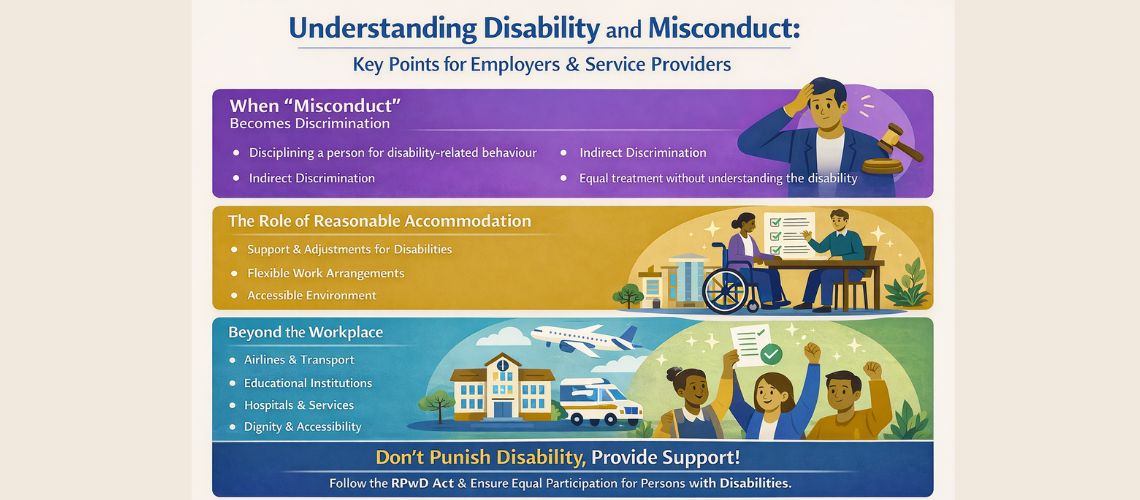
When “Misconduct” Can Become Discrimination
Many workplace rules are designed to apply equally to everyone. But sometimes a rule that appears neutral can unfairly impact persons with disabilities.
This is called indirect discrimination.
For example:
- A person with a psychosocial disability may show behaviour that others consider inappropriate.
- If the employer punishes the person without understanding the disability, the disciplinary process itself may become discriminatory and contribute to disability discrimination in the workplace.
The Supreme Court highlighted this issue in Ravinder Kumar Dhariwal v. Union of India, where disciplinary proceedings were initiated against an employee with a mental health condition. A deeper analysis of this important judgment can be found in Punished for Disability? The Supreme Court’s Clear Message on Mental Health and Misconduct.
The Court observed that persons with psychosocial disabilities may be more vulnerable to behaviour that is misunderstood as misconduct. If disciplinary action ignores the disability, it places them at a disproportionate disadvantage compared to others.
Several other landmark rulings have also played a significant role in strengthening disability protections in India. You can explore these decisions in Supreme Court Disability Rights Cases That Shaped Indian Law.
The message from the Court is clear:
Institutions must consider disability before initiating punishment.
The Role of Reasonable Accommodation
The concept of reasonable accommodation lies at the heart of the RPwD Act.
Reasonable accommodation means:
Making necessary adjustments so that persons with disabilities can participate equally in work, education, services, and public life.
Instead of punishment, organisations must ask:
- Is the behaviour related to the disability?
- Can support or accommodation solve the problem?
- Can workplace rules be adjusted to enable inclusion?
Examples of reasonable accommodation include:
- Flexible working arrangements
- Supportive supervision
- Adjustments in duties or environment
- Access to mental health support
- Alternative communication or reporting systems
Failure to provide reasonable accommodation may itself amount to disability discrimination in the workplace under the RPwD Act.
When organisations ignore these obligations, individuals may also choose to pursue legal remedies under disability law. Understanding how to issue an RPwD Act Legal Notice can help persons with disabilities formally assert their rights.
Disability Rights Apply Beyond the Workplace
These principles are not limited to employment.
They also apply to service providers, including:
- Airlines
- Transport operators
- Educational institutions
- Hospitals
- Public services
For instance, aviation regulations require airlines to ensure dignity and assistance for passengers with disabilities.
Once a passenger with disability informs the airline about their needs and confirms the ticket, airlines should not repeatedly question or harass them about their disability requirements.
This rule protects passengers from what is often called “disclosure fatigue”—being forced to repeatedly explain their disability.
The law recognises that dignity, privacy, and accessibility are essential parts of equal participation.
From Punishment to Inclusion
India’s disability law is moving from a punishment-based approach to an inclusion-based approach.
Earlier systems focused on discipline and uniform rules.
Today, the law emphasises:
- Equality
- Accessibility
- Reasonable accommodation
- Respect for dignity
This change reflects a broader human rights approach to disability.
Disability is no longer viewed only as a medical condition. Instead, it is understood as the interaction between a person’s impairment and barriers in society.
When institutions remove those barriers, people with disabilities can participate fully and equally.
Conclusion
The key lesson for organisations and service providers is simple:
Not every rule violation is misconduct. Sometimes it is a disability-related issue.
Before taking disciplinary action, institutions must ask whether reasonable accommodation could resolve the situation.
Punishing behaviour linked to disability may not just be unfair—it may also contribute to disability discrimination in the workplace.
In cases where rights are violated, legal protections under the RPwD Act—including provisions such as Section 92 of the RPwD Act—provide penalties for crimes committed against persons with disabilities.
The RPwD Act and recent Supreme Court decisions make it clear that the goal is not punishment, but equal participation with dignity.