
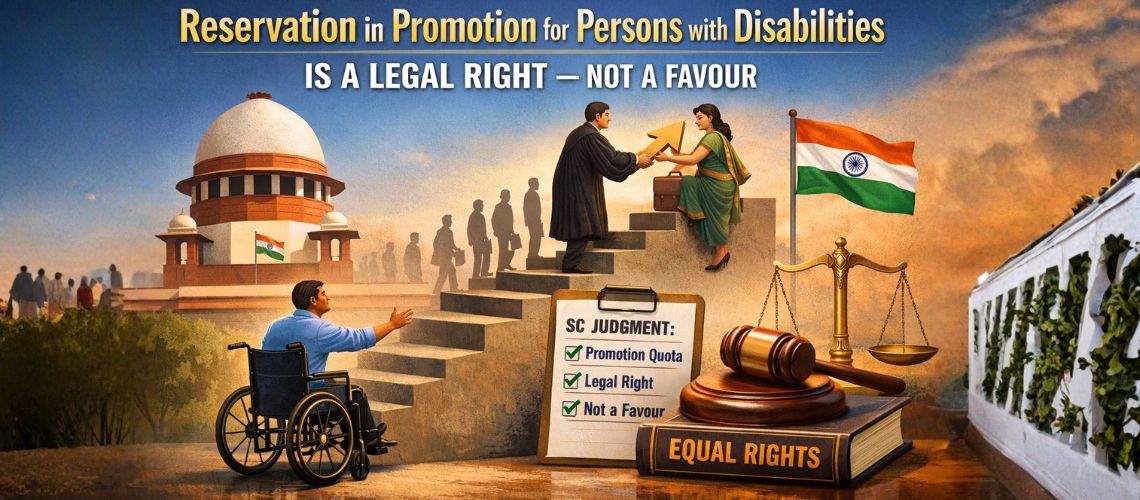
Supreme Court’s Ruling in Leesamma Joseph and What It Means for Government Employees
A Supreme Court Judgment Explained for Disabled Employees
For decades, persons with disabilities working in government service have been told a convenient half-truth.
They were told that the reservation applies only at the time of entry into service. They were told that promotion is a separate matter, governed entirely by service rules, seniority lists, and administrative discretion. In many cases, they were also told that if they were not appointed under the disability quota, they could never claim any disability-related benefit later in their career.
This reasoning produced one predictable result.
Persons with disabilities entered government service—but remained stuck at the bottom of the hierarchy for life.
The Supreme Court of India directly confronted this structural injustice in Leesamma Joseph v. State of Kerala (2021). The judgment goes to the heart of disability rights, equality in public employment, and the true purpose of reservation for persons with disabilities under Indian law, particularly the Rights of Persons with Disabilities Act, 2016.
This case is not merely about service rules or promotion procedures.
It is about whether the law permits the State to quietly freeze the careers of disabled employees.
The Background: A Familiar Story for Disabled Government Employees
Leesamma Joseph was a government employee in Kerala with more than 55% locomotor disability. She was appointed on compassionate grounds and not through the disability reservation quota. Over the years, she fulfilled all service requirements, cleared departmental examinations, and became fully eligible for promotion like her peers.
When her turn for promotion arrived, however, she was denied the benefit of reservation.
The State of Kerala relied on arguments that disabled employees across India hear repeatedly:
- Reservation in promotion was not expressly provided under the service rules
- Disability reservation applied only to direct recruitment, not promotion
- Promotional posts had not been formally identified for persons with disabilities
- Since she was not recruited under the disability quota, she could not claim its benefits later
These arguments mirror the systemic resistance documented across multiple Supreme Court disability rights cases that have shaped Indian law.
What makes this case significant is not the novelty of these arguments, but the fact that the Supreme Court rejected each of them without ambiguity.
The Core Legal Question Before the Supreme Court
At its core, the case raised a simple but far-reaching question:
Can the State deny a reservation in promotion to a person with disability by relying on administrative silence, procedural gaps, or the mode of appointment?
To answer this, the Supreme Court returned to first principles—examining the purpose of disability law itself and India’s obligations under domestic legislation and international human rights standards such as the UN Convention on the Rights of Persons with Disabilities (UNCRPD.
Reservation Under Disability Law Is About Career Progression, Not Mere Entry
The Court made it clear that reservations for persons with disabilities cannot be reduced to a one-time benefit available only at the stage of appointment.
If reservations were confined solely to entry-level posts, persons with disabilities would enter government service but never advance. Their careers would stagnate regardless of merit, experience, or seniority. Such an interpretation, the Court held, would render disability reservation meaningless.
The law does not exist to place disabled persons inside the system and then deny them growth.
Reservation in promotion is essential to ensure real equality, dignity, and meaningful participation in public employment.
Mode of Appointment Cannot Defeat Statutory Rights
One of the State’s key arguments was that Leesamma Joseph was appointed on compassionate grounds rather than under the disability quota. Therefore, according to the State, she could not later claim a reservation in promotion.
The Supreme Court decisively rejected this reasoning.
Disability is not a benefit that attaches to a particular recruitment channel. It is a legally recognised status that triggers statutory protections. Once a person qualifies as a person with disability under the law, their rights cannot be taken away based on how they entered service.
To hold otherwise would create two artificial classes of disabled employees—those entitled to career progression and those permanently excluded from it.
Such a distinction has no basis in disability law.
Administrative Delay Is Not a Legal Excuse
The State also argued that reservation in promotion could not be implemented because promotional posts had not been identified for persons with disabilities.
The Supreme Court was unequivocal in rejecting this excuse.
Failure to identify posts cannot be used to deny constitutional and statutory rights. Administrative inaction cannot override legislative mandates. If the State’s argument were accepted, governments could indefinitely delay identification exercises and effectively nullify disability reservation altogether.
The Court held that the burden of compliance lies squarely on the State, not on disabled employees.
What the Judgment Clearly Establishes
The Supreme Court clarified several crucial principles:
- Reservation in promotion for persons with disabilities is part of the right to equality in employment
- It cannot be restricted only to the stage of initial recruitment
- Mode of appointment does not defeat disability-related entitlements
- Administrative silence, delay, or non-identification of posts is not a valid justification for denial
In simple terms, reservation in promotion is not a favour granted by departments at their convenience. It is a legal right flowing from disability law and constitutional equality.
Why This Judgment Matters Beyond One Case
For thousands of disabled government employees across India, this judgment addresses a lived reality.
Many are recruited, retained, and relied upon by the State—but are quietly denied advancement year after year. Promotion is withheld not because of lack of merit, but because of systemic resistance to recognising disability as a dimension of equality.
The Supreme Court’s ruling makes it clear that such stagnation is not accidental. It is unlawful.
This judgment also strengthens the growing body of disability jurisprudence documented in the platform’s Case Law Library (explore case law).
Conclusion: Equality Does Not End at Appointment
This judgment is not only about promotion. It is about whether persons with disabilities are seen as equal participants in public service or as permanent subordinates.
The Supreme Court has chosen equality, dignity, and career progression.
It is now for governments and departments to comply—not selectively, not reluctantly, but in full recognition that reservation in promotion for persons with disabilities is a legal right, not charity.