
A Supreme Court Judgment Explained Without Diluting Disability Rights
Disability rights law in India is often misunderstood in two completely opposite ways.
On some occasions, authorities shrink the law so aggressively that even clear cases of discrimination against persons with disabilities are denied protection. On other occasions, well-meaning arguments stretch the law so broadly that every medical condition is claimed as a disability.
Both approaches are harmful.
The first erases rights. The second dilutes them.
This delicate balance was addressed by the Supreme Court disability rights ruling in India in Nawal Kishore Sharma v. Union of India (2021). The judgment is significant not because it expands disability rights, but because it explains why legal precision is essential to preserve them.
The Context: Illness, Employment, and the Expectation of Protection
Nawal Kishore Sharma was a seafarer engaged on a foreign-going vessel. During his service, he was diagnosed with Dilated Cardiomyopathy, a serious heart condition. He was subsequently declared permanently unfit for sea service.
He claimed full disability compensation under the National Maritime Board Agreement. He also argued that his medical condition should be treated as a disability under Indian disability law, entitling him to protection and accommodation.
At first glance, this appears to be a familiar disability rights claim—loss of livelihood due to medical unfitness and an expectation of legal protection. However, the Supreme Court approached the issue with caution and clarity. It deliberately separated three concepts that are often wrongly merged:
- medical illness,
- contractual employment benefits, and
- statutory disability rights.
This analytical separation lies at the heart of the judgment.
When Courts Refuse to Rewrite Contracts in the Name of Sympathy
The first issue before the Court concerned compensation under the maritime agreement.
The agreement granted 100% disability compensation only where a seaman became unfit due to an injury suffered during employment. The appellant did not claim any accident or work-related injury. His medical condition was not shown to have been caused by any incident on the vessel.
The Supreme Court refused to stretch the meaning of “injury” to include every deterioration of health.
This refusal matters.
The Court clarified that beneficial interpretation cannot be used to rewrite negotiated contracts. If courts convert every illness into an employment injury, contractual certainty collapses. Compassion cannot replace legal meaning.
This reasoning does not deny empathy—it insists on legal honesty.
Medical Unfitness Is Not the Same as Disability
The Court then addressed a crucial assumption: that being unfit for a particular job automatically amounts to total disability.
The Supreme Court rejected this idea.
A person may be medically unfit for one category of work and still be capable of performing other forms of employment and daily activities. Dilated Cardiomyopathy prevented the appellant from performing sea duties, but it did not render him incapable of participating in society.
This distinction is central to understanding disability rights jurisprudence and is a recurring theme in the Supreme Court disability rights ruling in India.
Disability law does not protect people simply because they cannot perform a specific job. It protects people whose impairments substantially limit their participation in society due to existing social and structural barriers—an approach rooted in international disability rights standards such as the UN Convention on the Rights of Persons with Disabilities.
What Disability Means Under the RPwD Act, 2016
This is where the Rights of Persons with Disabilities Act, 2016, becomes critical.
The RPwD Act deliberately moves away from viewing disability as a purely medical concept. Instead:
- Section 2(s) defines a person with disability as someone whose long-term physical, mental, intellectual, or sensory impairment, in interaction with barriers, hinders full and effective participation in society on an equal basis with others.
In simple terms, the law asks not only, “Is there a medical condition?” but also, “Does this condition, when combined with barriers, restrict equal participation?”
Not every illness satisfies this test.
Why Not Every Illness Can Be Judicially Declared a Disability
The appellant argued that his heart condition should be treated as a disability under both the 1995 and 2016 disability laws.
The Supreme Court examined the statutory framework carefully.
Under the Persons with Disabilities Act, 1995, disability was defined through specific categories such as locomotor disability, visual impairment, mental illness, and hearing impairment. Heart conditions were not included.
The RPwD Act, 2016, expanded the scope of disability but did not eliminate statutory boundaries. It still requires that the impairment be long-term and socially limiting in its effect.
On the facts of this case, the Court held that Dilated Cardiomyopathy did not meet this legal threshold. Importantly, the Court refused to judicially insert new disabilities into the statute merely because the claim appeared sympathetic.
For readers interested in how courts have interpreted disability law across different contexts, the Case Law Library provides access to comparable judgments.
Why This Judgment Actually Protects Disability Rights
This judgment is sometimes misread as being anti–disability rights. That interpretation is incorrect.
What the Supreme Court disability rights ruling in India protects is the integrity of disability law itself.
If every illness is treated as a disability, the concept loses clarity. Resources meant for persons facing structural exclusion become overstretched. Most importantly, disability risks being reduced to a purely medical label—precisely what the RPwD Act sought to move away from.
For a broader understanding of how constitutional courts have shaped disability jurisprudence, readers may also explore Supreme Court disability rights cases that shaped Indian law.
Reading Judgments Carefully: Why Interpretation Matters
Judgments like this can be misused by authorities to deny legitimate disability claims if read without context. That is why rights-based interpretation matters.
Understanding your legal protections under disability law is essential. The Know Your Rights section provides a structured explanation of statutory safeguards available to persons with disabilities in India.
Advocates and scholars—including Dr. Arvinder Singh—have consistently emphasised that disability rights advance not by stretching definitions indiscriminately, but by enforcing the law robustly where it clearly applies.
The Larger Legal Principle
The Supreme Court reaffirmed a foundational principle of rights jurisprudence:
Courts cannot expand statutory categories solely based on sympathy. Rights flow from law, not emotion. When courts respect this boundary, they preserve the credibility and strength of rights-based claims.
This judgment therefore safeguards disability law from dilution—ensuring that when the law is invoked, it speaks with authority.
Closing Reflection
Nawal Kishore Sharma v. Union of India reminds us that disability rights are strongest when they are precise.
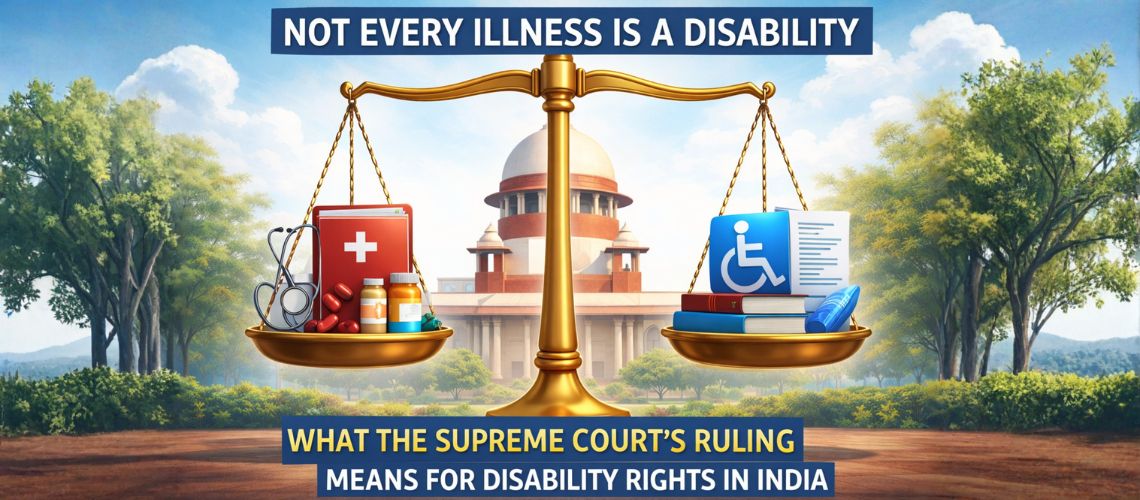
Not every illness is a disability.
Not every unfitness is discrimination.
But where disability law applies, it applies with full constitutional force.
For individuals facing denial of rights or accessibility barriers, guidance on enforcement mechanisms is available through How to file a disability complaint in India.
Understanding this balance is essential—for courts, administrators, and the disability rights movement itself.