
A ramp that stops halfway. A lift that exists only on paper. A government website that screen-reader software cannot parse. For millions of persons with disabilities across India, these are not abstract policy failures — they are daily realities. The legal framework that should prevent them exists. The question has always been whether courts would enforce it.
The answer, over the past two decades, has increasingly been yes. A growing body of judicial decisions has transformed accessibility law in India from a collection of aspirational provisions into enforceable rights. These rulings — from the Supreme Court and High Courts — have held governments and institutions accountable, struck down rules that undermined the law’s intent, and established the principle that access is not a favour but a constitutional guarantee.
This blog examines the cases that have most significantly shaped the legal landscape, what they established, and why they continue to matter for anyone working to make India genuinely inclusive.
The Legal Foundation: From the 1995 Act to the RPwD Act, 2016
India’s first dedicated legislation on disability rights — the Persons with Disabilities Act, 1995 — was a significant step forward but contained only three provisions directly addressing accessibility. Enforcement mechanisms were weak, and the language around compliance was largely aspirational. Real change came with the Rights of Persons with Disabilities Act, 2016, which aligned Indian law with the United Nations Convention on the Rights of Persons with Disabilities and expanded protections considerably.
Sections 40 to 46 of the 2016 Act lay down accessibility standards for buildings, transport, information and communication technology, and public services. Section 89 provides for penalties in cases of non-compliance. On paper, accessibility rights India law had never been stronger. In practice, implementation remained uneven — and it fell to the courts to bridge the gap between the statute and the street.
Rajive Raturi v. Union of India: Making Accessibility Mandatory
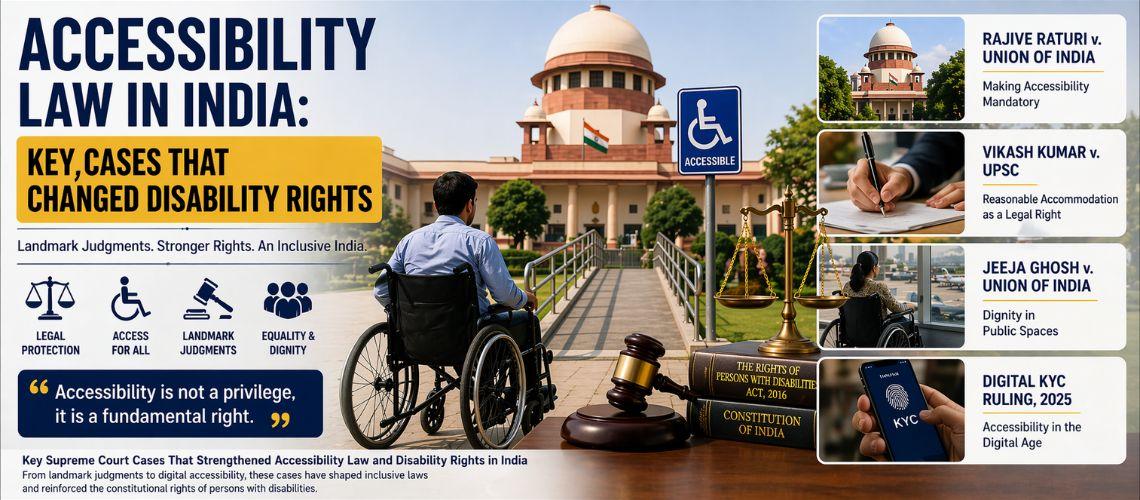
Perhaps the most consequential of recent accessibility law India cases is the Supreme Court’s November 2024 judgment in Rajive Raturi v. Union of India (Writ Petition (C) No. 243 of 2005). The petition was filed nearly two decades earlier by a visually impaired human rights advocate who sought judicial intervention to ensure meaningful access to public spaces. It took twenty years, two Supreme Court orders, and a detailed compliance study by NALSAR University’s Centre for Disability Studies to produce a ruling that fundamentally changed how accessibility obligations are understood.
The central issue was Rule 15 of the Rights of Persons with Disabilities Rules, 2017. Despite the parent Act using the word ‘shall’ throughout its accessibility provisions — language that is unambiguously mandatory — Rule 15 used recommendatory terms like ‘may’ and ‘recommend’. The Union of India had been claiming these rules were binding. The Supreme Court disagreed sharply.
The bench held that Rule 15 was ultra vires the parent Act because it failed to prescribe a mandatory floor of accessibility standards as Section 40 required. The Court directed the Union Government to frame non-negotiable, binding rules within three months. It also ordered that consequences under Sections 44, 45, 46, and 89 of the RPwD Act — including withholding of completion certificates and financial penalties — be applied to institutions that fail to comply.
In the Court’s own words: “Accessibility is not merely a convenience, but a fundamental requirement for enabling individuals, particularly those with disabilities, to exercise their rights fully and equally.” This framing — accessibility as a precondition for other rights, not an add-on — represents a significant shift in how accessibility law in India is conceptualised.
Vikash Kumar v. UPSC: Reasonable Accommodation as a Legal Right
In February 2021, the Supreme Court ruled in Vikash Kumar v. Union Public Service Commission that a candidate with Writer’s Cramp — a neurological condition affecting the ability to write — was entitled to a scribe in the Civil Services Examination. The UPSC had refused, citing rules that limited scribe access to candidates with specific categories of disability meeting a 40% threshold. The Court found this position untenable. Among the most significant disability accessibility cases in India, this one shifted the legal basis for accommodation from categorical eligibility to individual functional need.
The judgment drew on Section 3 of the RPwD Act, which prohibits discrimination on the basis of disability, and held that denying a reasonable accommodation constitutes exactly that kind of discrimination. The Court moved explicitly away from the medical model — which defines disability as an individual impairment requiring charity-based accommodation — towards the social and human rights model, which places the obligation on institutions to remove barriers.
The ruling also clarified that benchmark disability status — a classification under the RPwD Act for specific entitlements like reservations — is not a precondition for reasonable accommodation. Anyone whose disability creates a functional barrier is entitled to have that barrier addressed. This principle now underpins much of how accessibility rights India law is applied in examination and employment settings.
Jeeja Ghosh v. Union of India: Dignity in Public Spaces
Earlier than both, the 2016 Supreme Court judgment in Jeeja Ghosh v. Union of India established important ground for the cases that would follow. Ms. Jeeja Ghosh, a disability rights activist with cerebral palsy, was forcibly offloaded from an aircraft on her way to speak at a conference. The airline had determined unilaterally that her disability made her a safety risk.
The Supreme Court held that the airline’s decision was both disproportionate and discriminatory. It directed the Directorate General of Civil Aviation to overhaul its guidelines on passengers with disabilities and underscored that the right to equal treatment extends to public transport. The case is a foundational reference point in RPwD Act accessibility cases involving transport, and it remains relevant today as advocates push for accessible railway infrastructure, airports, and public transit.
You can also explore aviation-specific disability rights here: Air Carriage Rules for Persons with Disabilities
The 2025 Digital KYC Ruling: Accessibility Enters the Digital Age
In April 2025, the Supreme Court issued a judgment that brought accessibility law India cases into the digital era. The case arose from writ petitions challenging the systemic exclusion of persons with visual impairments and facial disfigurements from digital Know Your Customer (KYC) verification processes — a gateway to banking, mobile services, and government schemes.
The Court held that digital access is an intrinsic component of the right to life under Article 21 of the Constitution. It declared the RPwD Act, 2016 a ‘super-statute’ with quasi-constitutional standing, meaning that violations of its provisions amount to breaches of fundamental rights. The judgment directed the establishment of nodal officers for disability grievances, mandatory accessibility audits of digital platforms, dedicated helplines for KYC assistance, and human review mechanisms for cases where automated systems fail disabled users.
This ruling builds directly on Rajive Raturi and Vikash Kumar to establish that disability accessibility cases in India are no longer confined to physical barriers — they encompass every space, digital or physical, where exclusion can occur.
Learn more about enforcing your rights using RTI: RTI for Disability Rights in India
What These Rulings Tell Us About the Path Forward
Taken together, these judgments reveal several clear patterns. Courts have consistently held that accessibility obligations are not discretionary. They have moved from the older, charity-oriented framing of disability towards one grounded in constitutional rights and human dignity. They have applied the social model — which locates the problem in structural barriers rather than individual impairment — and used it to hold institutions to higher standards than they set for themselves.
They also reveal the limits of legislation without enforcement. The 2016 Act was a strong law. But it took sustained litigation over years — and a Supreme Court finding that implementing rules were unlawful — to move the needle on mandatory compliance. The judiciary has done significant work. The question now is whether the executive will follow through.
For persons with disabilities, their families, and organisations working in this space, knowing these cases is not merely of academic interest. They are the tools available for asserting rights — in complaints, in court, and in conversations with institutions that have so far treated accessibility as optional.
Conclusion
The arc of accessibility law India cases over the past two decades bends clearly towards a stronger, more rights-based framework. From transport and examinations to public buildings and digital infrastructure, courts have repeatedly affirmed that persons with disabilities are rights holders, not beneficiaries of goodwill.
But legal victories in courtrooms need to translate into ramps that are actually built, websites that actually work, and examination policies that actually accommodate. Judicial decisions establish the floor. Advocacy, compliance monitoring, and community awareness raise the ceiling.
Understanding the law — including the cases that have shaped it — is the starting point for anyone determined to make that translation happen.
Take Action: Turn Legal Rights into Real Change
Understanding these landmark cases is only the first step — using them is what creates impact.
If you or someone you know is facing accessibility barriers or discrimination:
👉 Learn how to take action and file a complaint: How to File Disability Complaint in India
- 📄 Take legal action against violations
- ⚖️ Assert your rights under the RPwD Act
- 📢 Hold institutions accountable
Because accessibility is not a privilege — it is a legal right.