


Raising Awareness About Accessibility, Inclusive Education, and Equal Rights for Persons with Disabilities
India has made important legal and constitutional commitments toward protecting the rights of persons with disabilities. However, the reality on the ground continues to expose serious accessibility gaps in government offices, educational institutions, and public infrastructure.
To bring greater public attention to these issues, the Dr. Arvinder Singh & Dainik Bhaskar Initiative for Disability Rights has highlighted the everyday barriers faced by persons with disabilities in India. Through powerful newspaper coverage and public awareness discussions, the initiative focuses on accessibility rights, inclusive infrastructure, disability-friendly governance, and equal educational opportunities.
The recent awareness campaign published in Dainik Bhaskar highlighted major concerns in Udaipur — inaccessible government offices and the lack of disability-friendly infrastructure in schools.
These reports reflect a larger national issue where accessibility often remains limited to paperwork rather than practical implementation.

Accessibility Challenges in Government Offices Continue to Affect Disabled Citizens
One of the newspaper reports focused on the condition of accessibility facilities in major government offices in Udaipur.
Despite clear legal provisions under the Rights of Persons with Disabilities (RPWD) Act, 2016, several public offices reportedly remain difficult to access for wheelchair users, senior citizens, and individuals with mobility challenges.
The report highlighted several concerns, including:
- Ramps blocked by parked vehicles
- Missing ramps in important offices
- Lack of lifts in multi-floor buildings
- Poorly planned accessibility infrastructure
- Inaccessible pathways for wheelchair users
- Lack of alternative arrangements for disabled visitors
- Limited support for visually impaired individuals
In several locations, ramps formally exist but remain practically unusable because of parking issues and poor implementation.
For persons with disabilities, these barriers are not minor inconveniences. They directly affect dignity, independence, mobility, and equal access to public services.
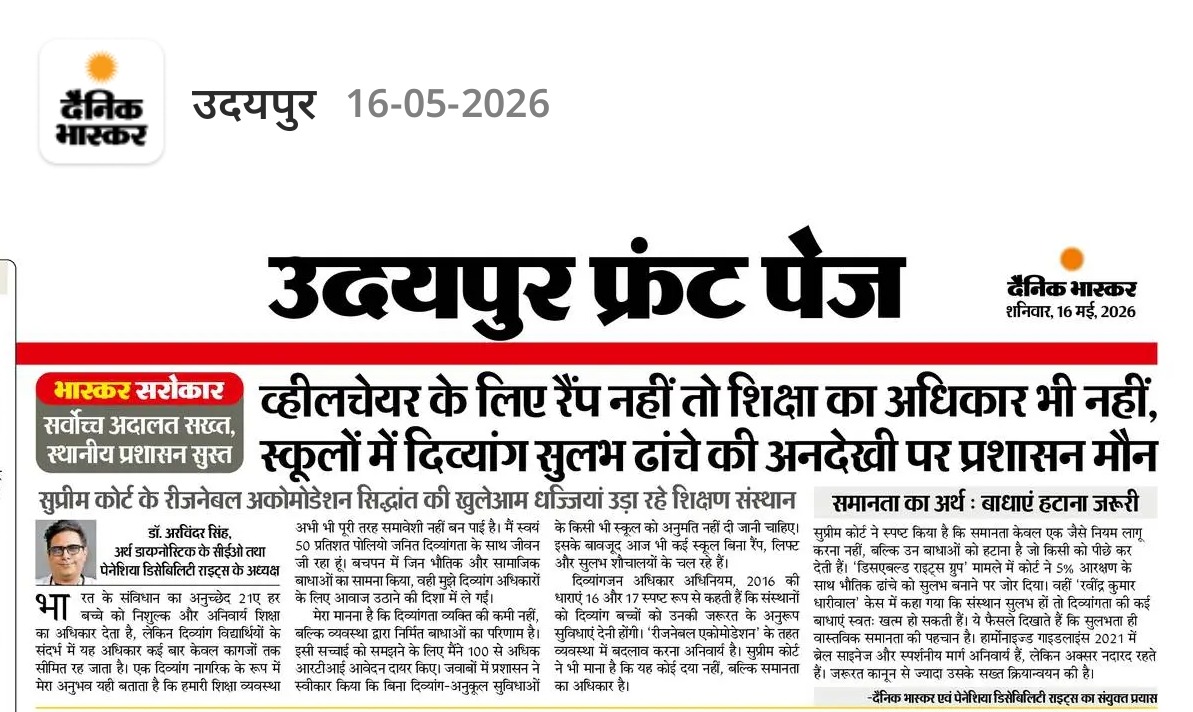
Inclusive Education Cannot Exist Without Accessibility
The second awareness report highlighted another serious concern — inaccessible educational institutions.
The report pointed out that many schools still lack proper wheelchair ramps and disability-friendly infrastructure, making education difficult to access for children with disabilities.
The discussion emphasized a powerful message:
“If there is no ramp for a wheelchair, there is effectively no right to education.”
Educational accessibility is directly connected with equality and social inclusion. When schools fail to provide basic accessible infrastructure, students with disabilities are automatically excluded from independent participation in education.
The report also stressed that inclusive education should not remain limited to policies and announcements. Real implementation at the ground level is equally necessary.
Accessibility Is a Constitutional and Human Rights Issue
Accessibility is not a favor or a symbolic gesture.
Under the Rights of Persons with Disabilities Act, 2016, all public institutions are legally required to ensure barrier-free access for persons with disabilities.
The Supreme Court of India has repeatedly clarified that inaccessible public infrastructure violates the dignity and fundamental rights guaranteed under Article 21 of the Constitution.
Accessibility is directly connected with:
- Equality
- Human dignity
- Independent living
- Equal participation in society
- Access to education and governance
- Inclusive public services
- Freedom of movement
When government offices and educational institutions remain inaccessible, it reflects a larger governance and implementation challenge.
Dr. Arvinder Singh Highlights the Need for Real Accessibility Implementation
Dr. Arvinder Singh has consistently emphasized that the progress of a society is measured by how it treats its most vulnerable citizens.
While speaking on the issue of accessibility, Dr. Arvinder Singh highlighted that despite clear legal provisions and Supreme Court observations, persons with disabilities continue to struggle with basic accessibility in India.
According to him:
- Accessibility is a constitutional responsibility
- Equality cannot exist without removing barriers
- Inclusive infrastructure is a human rights issue
- Accessibility should move beyond symbolic compliance
- Real implementation and accountability are urgently needed
He also emphasized that inaccessible government offices and schools create unnecessary barriers for disabled citizens trying to access education, healthcare, public services, and administrative support.
Through the Dr. Arvinder Singh & Dainik Bhaskar Initiative for Disability Rights, awareness is being created around equal access, disability rights, and inclusive governance in India.
About Dr. Arvinder Singh
Dr. Arvinder Singh, CEO of Arth Diagnostics and president of Panacea Disability Activists, is actively involved in disability rights awareness, accessibility advocacy, healthcare ethics, medico-legal awareness, and inclusive social initiatives in India.
Dr. Arvinder Singh is also recognized as a three-time world record holder for his contributions and achievements in his field. Through awareness campaigns, educational discussions, and advocacy-based initiatives, he continues to encourage conversations around accessibility, equal rights, and inclusive development.
His collaboration with Dainik Bhaskar aims to create stronger public awareness regarding disability accessibility and the importance of inclusive infrastructure across public institutions.
Why Accessibility Audits and Inclusive Planning Are Necessary
One of the biggest challenges in India is the lack of regular accessibility audits in public infrastructure.
Many buildings are officially categorized as accessible despite having major usability problems, such as:
- Steep ramps
- Blocked entrances
- Missing handrails
- Inaccessible washrooms
- Lack of elevators
- Poor wheelchair movement space
- Improper signage systems
Accessibility should not be judged only through paperwork compliance. It must be evaluated based on real usability for persons with disabilities.
Government departments, schools, municipal authorities, and public institutions should conduct regular accessibility audits to identify and correct infrastructure gaps.
Public Awareness and Social Responsibility Matter
Accessibility is not only the responsibility of governments and institutions.
Citizens also play an important role in supporting inclusive environments. Parking vehicles in front of ramps, blocking accessible pathways, or ignoring disability-friendly infrastructure creates avoidable barriers for disabled individuals.
Public awareness campaigns can help society better understand:
- The importance of accessibility
- Rights of persons with disabilities
- Respect for accessible infrastructure
- Inclusive social behavior
- Equal participation for disabled citizens
The Dr. Arvinder Singh & Dainik Bhaskar Initiative for Disability Rights continues to highlight the real-life barriers faced by persons with disabilities in schools, government offices, and public spaces.
Accessibility Must Move Beyond Symbolism
India cannot achieve truly inclusive growth unless accessibility becomes a practical governance priority.
The concerns highlighted through this awareness initiative reflect larger systemic challenges that require attention from:
- Government departments
- Educational institutions
- Urban planners
- Civic authorities
- Public infrastructure agencies
- Society as a whole
Accessibility should never remain limited to symbolic infrastructure or paperwork compliance.
Real inclusion requires implementation, accountability, and social sensitivity.
An accessible environment is not a privilege.
It is a constitutional right, a human necessity, and an essential step toward building an equal and inclusive India.